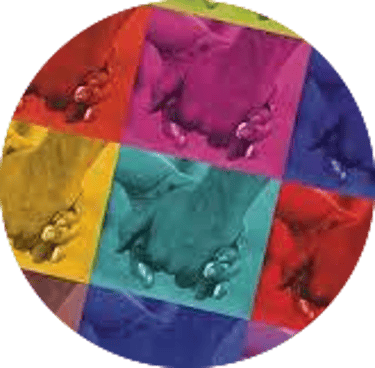
Relationships: Focusing on the Mystery and Poetry of the Other
How to live into a living field with others?
giovanna benatti
6/1/20264 min read


They complete us, provoke us, disorientate us, frighten us, and attract us. We feel their calling and attraction, yet at the same time fear their complexity. They tell us who we are and where we are in our evolution.
Relationships define our identity and our being in the world; they are a labyrinth, a challenge, and a great opportunity. But:
Why is relating to others so complex?
Why can't we detach ourselves from toxic relationships?
Why do we have the ability to build toxic relationships?
How can I remain an individual without creating co-dependencies?
How can I learn to accept conflict without disqualifying the other?
What is the weight of judgment and prejudice in my relationships?
How can I develop the ability to build healthy, nurturing relationships?
In this reflection, we pay homage to Edgar Morin, who recently passed away but lives on forever in his teachings and the legacy of his message.
For French sociologist and philosopher Edgar Morin, relationships are the connective tissue of existence. His thinking is based on the idea that there is no isolated "I," but that we are defined and understood only within the connections we establish with others and with the world.
His approach to relationships rests on these fundamental pillars: the primacy of the "We." Morin maintains that "there is no I without a we."
Human beings are complex entities defined through constant interaction with the community and the surrounding environment. Our individual identity and well-being are inextricably linked to what unites us to others.
In his studies of complexity, Morin harshly criticizes the paradigm of separation, or the tendency to fragment human knowledge and experience. Instead, he proposes the concept of reliance (from the French reliance): the art of weaving relationships, of connecting what has been separated, and of understanding that each element is part of a single open system.
Living and relating means understanding our mutual interdependence. Morin often speaks of self-eco-organization, or the awareness that our actions influence the group and the entire ecosystem. This requires a true ethics of relationships, one that promotes brotherhood and solidarity, necessary to resist the individualism, cruelty, and resentment of contemporary society.
Diversity must not be passively tolerated, but valued as a need for encounter and exchange. In his work on the "Seven Knowledges Necessary for the Education of the Future," Morin places the teaching of understanding among the foundations of social life. Understanding others requires profound empathy and a "loving pedagogy" that overcomes misunderstanding, egocentrism, and mutual contempt, always placing the mystery and poetry of the other at the center.
Chiara Massullo writes: "It is urgent to recognize the theoretical and operational dignity of love as a pedagogical category, exploring the connection between education and love and the potential of a 'pedagogy of love' that integrates affective, poetic, and relational dimensions.
Starting from the recognition of love as a complex and foundational energy of humanity, we question the reasons for its marginalization in the pedagogical debate, particularly in Italy. Through a philosophical-educational reading of some passages by Edgar Morin, the category of 'loving relating' is proposed as an educational modality that recognizes and preserves the poetry and mystery of the other, calling the educator to honor and develop their specific qualities. Finally, we must recognize the edifying power of love which, through 'theoretical-maieutic action,' makes the educational encounter a transformative event capable of igniting freedom and fostering the full humanization of the individual."
There is no such thing as the “I,” there is only the “WE,” writes Edgar Morin. When I meet the other, I begin to hear about myself, adds Rolando Toro, who founded the Biodanza system not so much as an individual therapy, but as a social pedagogy ("Saved education, redemption of instincts, and priority of relationships") for a more just and loving world.
We like to remember Rolando for his immense pedagogical legacy, for the immeasurable re-educational impact of Biodanza in terms of human ecology and relationships, and for his creation of the "Ladder of Bonding," recognizing that our culture (including educational culture) has fostered the lowest points of this ladder: individualism, egocentrism, competition, and personalism. Instead, our nature, when guided by affective intelligence—the most powerful intelligence—is inexorably drawn to epiphanic dimensions: the priority of "us" and dialogue.
When we let ourselves be guided by affective intelligence, the focus shifts to the importance of community and mutual communication; the social bond becomes central.
We enter a space of mutual nourishment of identity, recognizing the other as fundamental to our existence. The encounter allows the blossoming and authentic expression of both our potentials.
We develop empathy, that is, the profound ability to put ourselves in another's shoes, intimately understanding their emotional state.
And finally, as a state of bliss for our existence, we access the Epiphany of the Encounter: the highest level, the most seemingly inaccessible, but actually recorded in our cells. Rolando Toro draws inspiration from the philosopher Emmanuel Lévinas. Living in a state of epiphany of the encounter means and allows us to recognize the "sacred" in the other, where the encounter breaks down every defensive barrier to embrace universal unity.
Unfortunately, we won't find the answer to all these questions by letting ourselves be guided by the logical-cortical mind, because its master code is binary: I or YOU. The mind is a factory of beliefs, often tragically inherited or dramatically shaped by our environment. These beliefs shape our personality, our beliefs, which become a cage, or in the worst case, a prison.
We access the intelligence of the heart, which is not just a muscle, but a true sentient center, capable of memory and intuition, through absolutely transpersonal and experiential ways: dance, eros, emotional contact, play, laughter, nature, the absolute emotion of watching a sunset, musical mediumship, when sound inhabits us and our ego disappears.
When we dance, our mind rests and the mind of the heart, the cosmic mind, is activated: the vital and luminous unconscious, the layers of our Self that cannot be accessed through thought.
In this space of tenderness and mystery, the master code is the code of complexity: ALL is ONE. I am you. I am US. Diversity is a dance.
Then, yes, those questions will find peace and an answer.
Because, as Rolando Toro writes: love is an organizing force that transcends the individual.
And so, let's dance...let's dance...otherwise we are lost (Pina Bausch)
Giovanna Benatti